
Producing one
1
Pick a recipient
Choose someone from your list whose data you know well and whose reaction you can predict. A
person with rich data teaches you about the best case; a person with sparse data teaches you what
most of your list will look like. Do both.
2
Press Start production
The work runs in stages: writing this person’s script, speaking it, adapting the visuals and the
brand, producing the changed scenes, checking the result, and assembling their video.
3
Read what it decided
Beneath the stages runs a running commentary from the system: which dimensions it used, which it
skipped for lack of data, why it chose a particular background, what the final check objected to.
When something looks wrong in the video, this tells you whether it made a bad decision or
executed a reasonable one badly.
4
Watch the result
The plays that person’s video, with the same scene-by-scene
detail as any story.
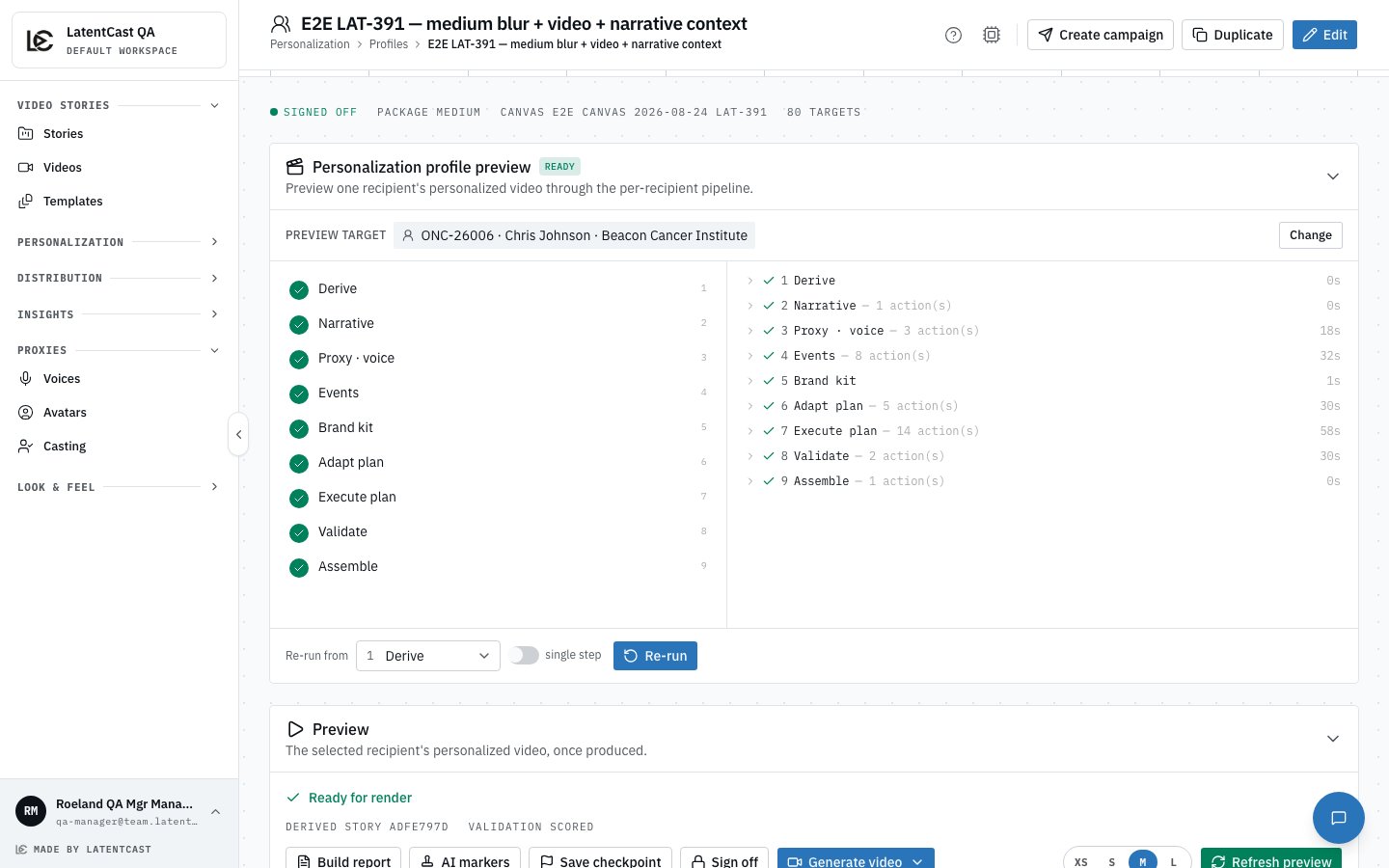
Producing one recipient: the stages on the left, what each one decided on the right, and controls to re-run from any point.
Judge it against these four questions
- Is everything it says about this person true? Check each personal claim against their row. This is the most important thing you will ever catch, and it is easiest to catch here.
- Does it sound like a person wrote it, or like a mail merge?
- Does your core story still work with the personal parts wrapped around it, or has the wrapper swamped the message?
- Would you send this, to this named person, today? That is the bar. Anything less means the rules are not ready.
Fixing what you find
Where you fix something depends on what is wrong:
Then produce again. Re-running from a later stage picks up where it left off rather than redoing
everything, so iterating is quick.
The result is a real story
What comes out is not a locked artefact. It is a story of its own, belonging to that recipient, with their identity pinned at the top and their canvas row a click away. The tuning chat works on it as usual.Edits there change that person’s video only. They never touch the base story and never reach any
other recipient. That is exactly what you want when one video needs a small fix, and it is why the
generic production workflow is not offered on a personalized story: re-running it would strip the
personalization out.
Before you move on to a campaign
- You have watched at least two produced recipients, one data-rich and one sparse.
- Every personal claim in both is true and came from the list.
- You would send both, unedited.
Next
Campaigns and batches
Produce the whole list, in groups you control.
What you can personalize
Adjust the rules if the result was not right.