> ## Documentation Index
> Fetch the complete documentation index at: https://www.latentcast.com/docs/llms.txt
> Use this file to discover all available pages before exploring further.
# Preparing your recipient list
> The spreadsheet that decides what every recipient's video can say — its columns, how to check it, and why accuracy matters more here than anywhere else.
**Where:** Personalization ▸ Canvases, then **New Canvas**
Your recipient list becomes a canvas: one row per person, one column per
thing that may differ in their video. It is the only place LatentCast learns anything about a
recipient, so everything a video says about someone comes from a cell in this sheet.
## What the columns are for
| Group | Columns | What it feeds |
| ------------------------ | --------------------------------------------------------------------------------- | --------------------------------------------------------------------------------------- |
| **Who they are** | recipient id, full name, email, role, company, industry, country | Who the video is for |
| **Who presents** | presenter email, first and last name | The colleague on screen, and the [cast](/docs/guides/personalization/presenters-and-consent) |
| **Why now** | spoken personal name, spoken company name, triggering event, relationship context | The personal opening |
| **What they care about** | strategic priorities, relevance signals | The optional context scene |
| **Look** | recipient imagery, attire colour, clothing style | Their imagery and the presenter's appearance |
| **Language and page** | language, subtitles, welcome message, call to action | Translation and the [viewing page](/docs/guides/campaigns/viewing-pages) |
The identity columns are required. Everything else is optional, and an optional column you do not
have is simply a column you leave out.
## Building one
Drop your Excel file in. LatentCast reads it and shows a report: how many recipients it found,
how many things it can personalize, which sheets it read, and any warnings. A chat panel beside
it answers questions about your own data — what is missing, what looks thin, what looks wrong.
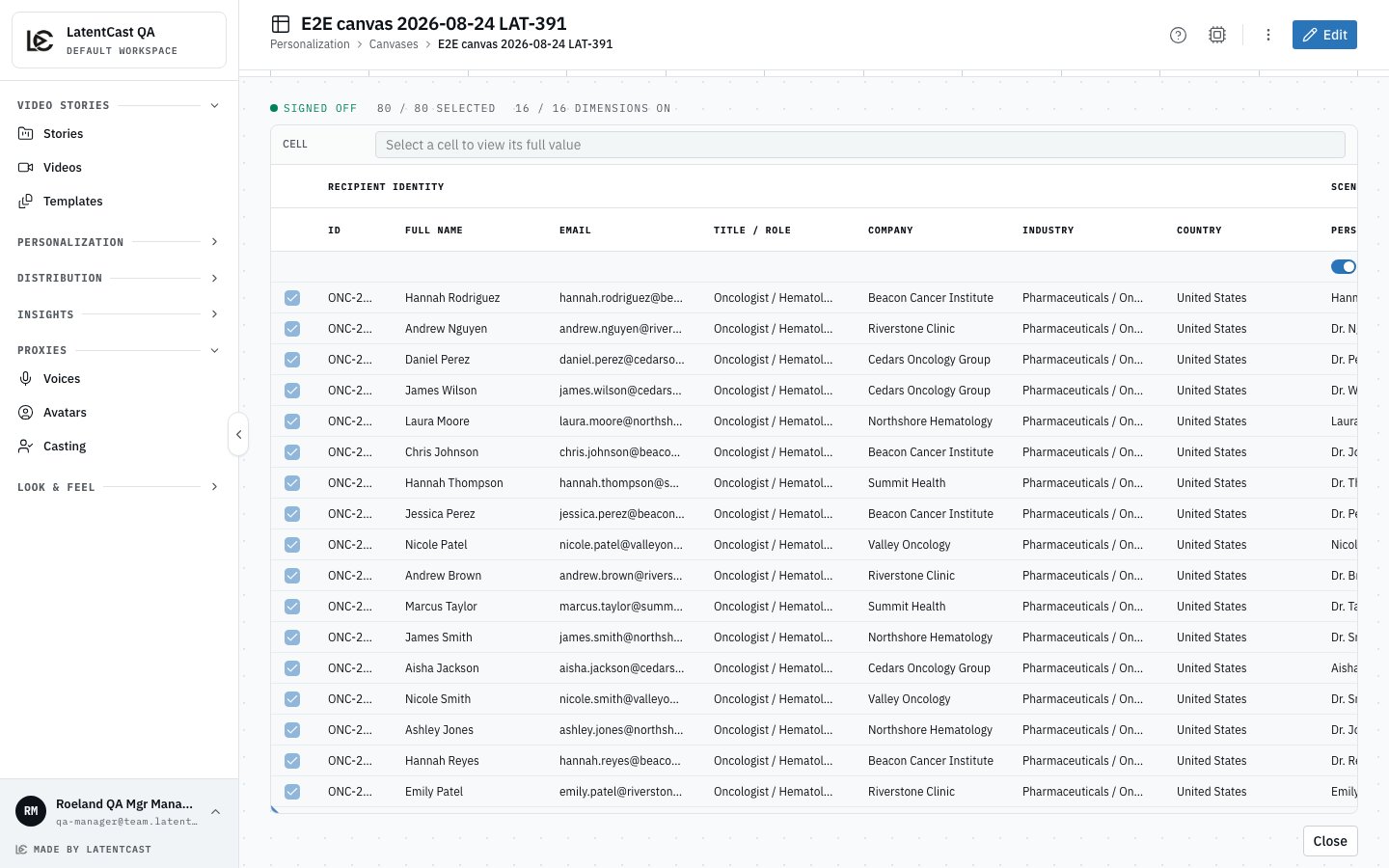
Your list opens as a grid. Read it the way the video will read it. Fix what is wrong, tick the
rows you want to include, and leave out any column you do not want used at all. Your original
file is never touched.
Confirm this is the dataset. The canvas is frozen, becomes read-only, and can now be chosen in a
personalization profile.
 ## The rule that explains almost everything
Three things have to agree before a video says something personal about someone:
1. **The profile asks for it.** Your [personalization profile](/docs/guides/personalization/building-a-profile)
decides what you want personalized. It is the first and decisive gate.
2. **The column is present and in use.** A column you left out, or switched off in the grid, is not
available to any profile.
3. **That person's cell has something in it.**
If any of the three is missing, that dimension is skipped for that person and the video carries on
without it. **Nothing is guessed, filled in, or invented to cover a gap.**
This is why two people in the same list can get noticeably different videos. One had a triggering
event and a relationship note; the other had blanks, so their video simply does not mention either.
**Whatever is in a cell will be said to a real person, as fact.** A stale triggering event, an old
job title, a company that has since been acquired — each becomes a confident, personal statement in
a video you send. Accuracy is won or lost in this grid, and no later step will catch it for you.
## Practical advice
* **Leave a cell blank rather than guessing.** A blank is handled gracefully. A wrong value is not.
* **Use the email address each presenter signs in with.** That is how they are matched to their
casting request.
* **Start with a small list.** Ten rows you know well will teach you more than four hundred.
* **Re-upload rather than patch** when your source data changes substantially. A canvas is frozen
after sign-off, so a new version is the clean path.
## Before you move on
* Every row has a name, an email, a company and a presenter.
* You have read the trigger and context cells and would stand behind each one out loud.
* The canvas shows as signed off.
## Next
The menu of things that can differ per person.
Tie the story and the list together into one set of rules.
## The rule that explains almost everything
Three things have to agree before a video says something personal about someone:
1. **The profile asks for it.** Your [personalization profile](/docs/guides/personalization/building-a-profile)
decides what you want personalized. It is the first and decisive gate.
2. **The column is present and in use.** A column you left out, or switched off in the grid, is not
available to any profile.
3. **That person's cell has something in it.**
If any of the three is missing, that dimension is skipped for that person and the video carries on
without it. **Nothing is guessed, filled in, or invented to cover a gap.**
This is why two people in the same list can get noticeably different videos. One had a triggering
event and a relationship note; the other had blanks, so their video simply does not mention either.
**Whatever is in a cell will be said to a real person, as fact.** A stale triggering event, an old
job title, a company that has since been acquired — each becomes a confident, personal statement in
a video you send. Accuracy is won or lost in this grid, and no later step will catch it for you.
## Practical advice
* **Leave a cell blank rather than guessing.** A blank is handled gracefully. A wrong value is not.
* **Use the email address each presenter signs in with.** That is how they are matched to their
casting request.
* **Start with a small list.** Ten rows you know well will teach you more than four hundred.
* **Re-upload rather than patch** when your source data changes substantially. A canvas is frozen
after sign-off, so a new version is the clean path.
## Before you move on
* Every row has a name, an email, a company and a presenter.
* You have read the trigger and context cells and would stand behind each one out loud.
* The canvas shows as signed off.
## Next
The menu of things that can differ per person.
Tie the story and the list together into one set of rules.