> ## Documentation Index
> Fetch the complete documentation index at: https://www.latentcast.com/docs/llms.txt
> Use this file to discover all available pages before exploring further.
# Pronunciation dictionaries
> Teach LatentCast how to say your product names, your customers' names and anything else it would otherwise guess at.
**Where:** Proxies ▸ Voices, in the **Pronunciation** section
Some words are guessed wrong by any speech system: a product name, a Nordic company, a founder's
surname, an abbreviation your industry says a particular way. A
pronunciation dictionary fixes them, everywhere and permanently.
It is worth doing. A video that mispronounces the recipient's own company undoes the personal touch
it was made for.
## What a dictionary holds
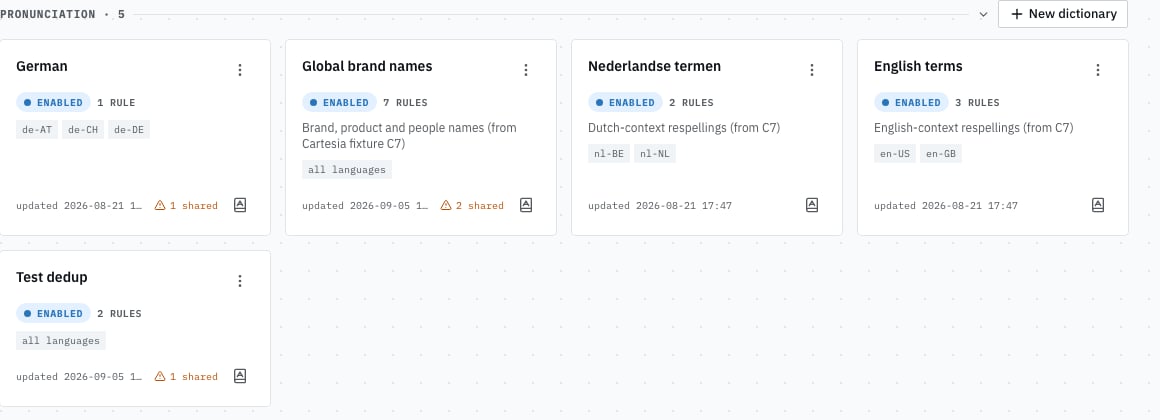
A dictionary is a named list of rules. A rule is a **term** as it is written in the script, and a
say-as: how it should be spoken.
You can have several dictionaries, and enable or disable each one. Split them the way you think:
one for your products, one per market, one for a customer list.
 ## Writing a say-as
Two notations, and the first is usually enough.
**A respelling** is the word written the way it sounds, in ordinary letters, read in the
dictionary's language. Write what you would tell a colleague over the phone.
| Term | Say-as |
| ------ | ----------- |
| Kebony | kuh-BOH-nee |
| Toreon | TOH-ray-on |
**A phonetic spelling** is exact, and unambiguous, in the standard phonetic alphabet. Use it when a
respelling keeps coming out slightly wrong. Write it between double angle brackets, and the editor
tidies the formatting for you.
**Start with a respelling and listen.** Reach for phonetics only when your ear says the respelling is
not landing. Most terms never need it.
## Listening
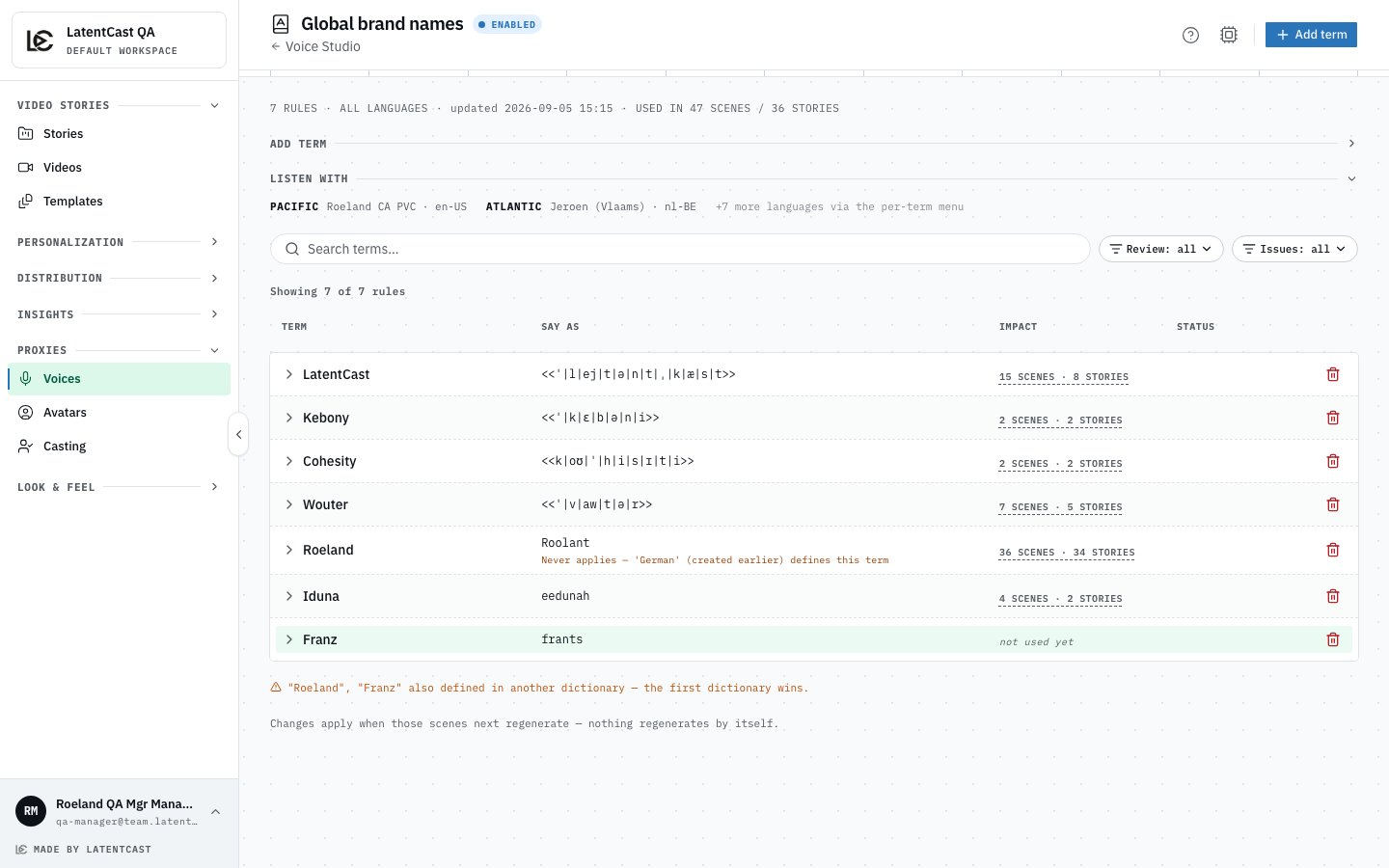
The point of the editor is that you can hear the result before anyone else does. Each rule has play
buttons, one per speech engine your organization uses, and a menu for the other languages you cover.
Type the customer's name, press play, and judge with your ears. That loop takes seconds and is the
only reliable way to get this right.
**If a rule was not applied, you are told.** When a preview plays without the dictionaries, a notice
says so rather than letting you conclude your rule is wrong. Listen again before rewriting a rule
that was never actually used.
## Writing a say-as
Two notations, and the first is usually enough.
**A respelling** is the word written the way it sounds, in ordinary letters, read in the
dictionary's language. Write what you would tell a colleague over the phone.
| Term | Say-as |
| ------ | ----------- |
| Kebony | kuh-BOH-nee |
| Toreon | TOH-ray-on |
**A phonetic spelling** is exact, and unambiguous, in the standard phonetic alphabet. Use it when a
respelling keeps coming out slightly wrong. Write it between double angle brackets, and the editor
tidies the formatting for you.
**Start with a respelling and listen.** Reach for phonetics only when your ear says the respelling is
not landing. Most terms never need it.
## Listening
The point of the editor is that you can hear the result before anyone else does. Each rule has play
buttons, one per speech engine your organization uses, and a menu for the other languages you cover.
Type the customer's name, press play, and judge with your ears. That loop takes seconds and is the
only reliable way to get this right.
**If a rule was not applied, you are told.** When a preview plays without the dictionaries, a notice
says so rather than letting you conclude your rule is wrong. Listen again before rewriting a rule
that was never actually used.
 ## Engines say things differently
Your organization may use more than one speech engine, and they do not respond identically to the
same instruction. Each rule can therefore be set per engine:
| Setting | Meaning |
| ----------- | ---------------------------------------------------------------------------------------------------- |
| **Inherit** | Use the say-as you wrote for the rule |
| **Custom** | Use a different spelling for this engine, pre-filled from your say-as so you edit rather than retype |
| **Default** | Send nothing for this engine and let it use its own pronunciation |
Set the rule once, listen on each engine, and only add an override where you actually hear a problem.
## Knowing what a rule affects
Each rule shows how many scenes and stories currently contain that term. Before changing a widely
used rule, that number tells you how much you are about to change.
## When two rules collide
If two enabled dictionaries define the same term, one of them wins and the other is marked as
shadowed, with a note telling you so. The same happens for two spellings of one word that differ only
in capitalisation.
That is why the warning matters: without it you would edit a rule, hear no change, and conclude the
feature was broken.
## Fixing a rule does not fix videos already made
**A rule takes effect the next time a scene is produced.** Videos that already exist keep the
pronunciation they were made with, and nothing re-records itself. If a name was said wrong in
something you have already sent, fix the rule and then produce that scene again.
Get your dictionaries in order before a campaign rather than after it.
## Next
What the assistant flags, and how to work through it.
Generate rules from a recipient list in one pass.
## Engines say things differently
Your organization may use more than one speech engine, and they do not respond identically to the
same instruction. Each rule can therefore be set per engine:
| Setting | Meaning |
| ----------- | ---------------------------------------------------------------------------------------------------- |
| **Inherit** | Use the say-as you wrote for the rule |
| **Custom** | Use a different spelling for this engine, pre-filled from your say-as so you edit rather than retype |
| **Default** | Send nothing for this engine and let it use its own pronunciation |
Set the rule once, listen on each engine, and only add an override where you actually hear a problem.
## Knowing what a rule affects
Each rule shows how many scenes and stories currently contain that term. Before changing a widely
used rule, that number tells you how much you are about to change.
## When two rules collide
If two enabled dictionaries define the same term, one of them wins and the other is marked as
shadowed, with a note telling you so. The same happens for two spellings of one word that differ only
in capitalisation.
That is why the warning matters: without it you would edit a rule, hear no change, and conclude the
feature was broken.
## Fixing a rule does not fix videos already made
**A rule takes effect the next time a scene is produced.** Videos that already exist keep the
pronunciation they were made with, and nothing re-records itself. If a name was said wrong in
something you have already sent, fix the rule and then produce that scene again.
Get your dictionaries in order before a campaign rather than after it.
## Next
What the assistant flags, and how to work through it.
Generate rules from a recipient list in one pass.